If you are like me and have never heard of this term before let me introduce you to the suggested name for the music coming out of the US Virgin Islands right now.
What exactly is B.R.A.M?
B.R.A.M is an accronym for Bass Rhythm and Music, someone jokingly said that it sounds just like the noise your car makes when you play the music bram bram bram.
I thought this was a new term the youths were coming up with shhh I know I am very close to what is considered middle aged now but this term is not new, apparently it has been suggested way back in 2020 or 2021. No confirmation on the exact date but take a glance at this instagram post below.
If you still have no idea what B.R.A.M is supposed to sound like don’t worry, I have found a song on Youtube for you to listen to. I will show you the difference between VI Soca and B.R.A.M. This is Virgin Islands B.R.A.M.
What is the difference between this and VI Soca? B.R.A.M seems to be a more modern fusion sound, they have a heavier influence of electronic music and relies more on dancehall and hip-hop. VI Soca has a more traditional sound with a stronger emphasis on brass instruments and relies more on calypso, reggae and funk. Here’s a youtube of VI Soca to enjoy.
How do I feel about B.R.A.M? It’s okay, I grew up with Soca and Calypso so those will always be my preferred music genres from the VI but it won’t stop me from listening to music and adding new artists to my expansive music collection. I listen to pretty much everything so I can always appreciate something new.
If there is one ancestor who has evaded all my research skills it is my 2x great grandmother Sarah Holm, the amount of evidence !i have that Sarah did exist is very minimal, five pieces of primary records, I have tried to look forward but couldn’t find her in any record after 1920, I have tried going backwards but hit a brick wall in 1908.
She is truly one of the most elusive people I have had to research and I can’t help but ponder, just who are you Sarah? Were you hiding from someone or just didn’t know your correct age?
Let’s go over everything I currently have, starting with the 1908 baptism record of my great uncle Harold Olanzo Smith. Harold was born on November 14, 1908 to Michael Smith of Tortola, British Virgin Islands and Sarah Holm of St. Thomas, Danish West Indies. Michael was 38 while Sarah was 33 at the time of Harold’s birth.
Harold Smith’s baptism line 286
1911 Census
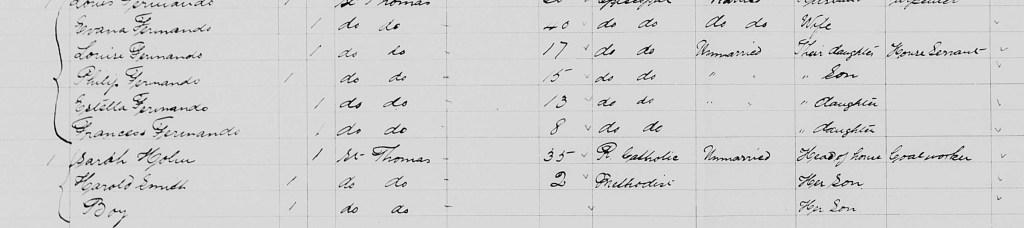
In 1911, Sarah lived in Mandenberg which was located in New Quarter on St. Thomas, she was 35 years old and worked as a Coal Worker and had two children, Harold 2 years old and another child identified as a boy with no age given.
Sarah and children located on the bottom
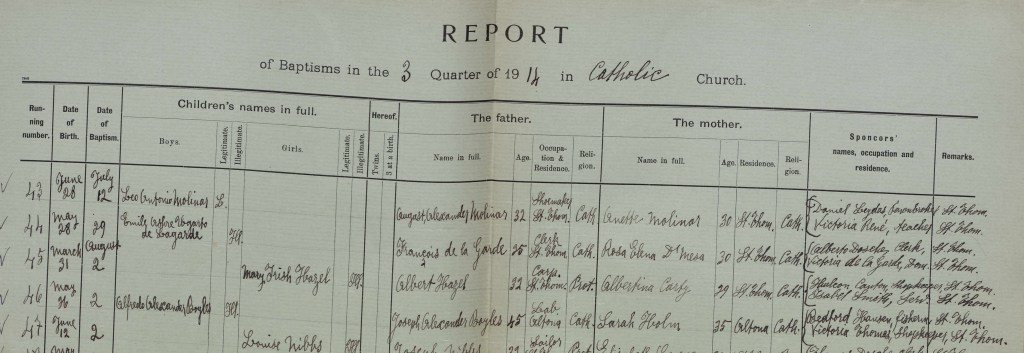
In 1914, Sarah gave birth to my great grandfather Alfredo Alexander Boyles also known as Alfredo Pedrito Boynes. Alfredo was born on May 26, 1914 to Joseph Alexander Boyles and Sarah Holm, Joseph was 45 years old and Sarah was 35, here is where the age discrepancies begin, in 1911 Sarah was 35, there is no way she was still 35 a whole 3 years later.
Alfredo Boyles’ baptism line 46
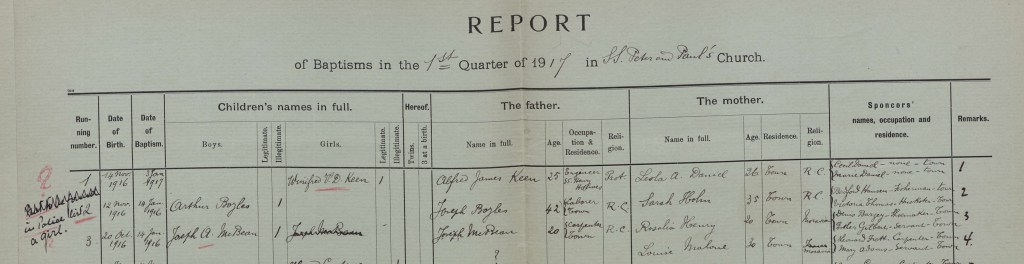
Sarah gave birth to my last great aunt in 1916. On November 12, 19166, Sarah and Joseph had another child, the baptism record lists the child as being male and named Arthur but on the left hand side there is a remark about the child actually being female. Joseph was 42 years old and Sarah was till 35 years old. Even more interesting Agatha later on gave her birth date as January 14, 1917 which was the date she was baptized.
Agatha Boyles’ baptism line 2
The last piece of primary source I could find, the 1920 Census, fun fact the 1920 Census was actually taken in 1917 up to 1918 so the dates are almost always wrong, sometimes I come across people with the right birth year but it’s mostly off by two years. In 1920, Sarah was living in Altona, which was located on the Southern East section of the island. She was 40 years old and living with three children, Mary J Griffith 11 years old, Agatha Boyles 1 years old, and Alfredo Boyles 3 years old. I’m not sure where Harold was at this time.
Sarah and children located on the bottom
An interesting piece of information I came across recently gave me some more clue to who Sarah might have been, this piece of information was an interview Mary Jane did when she was 99 years old. On October 9, 2004, In an interview with the St. Thomas Source, Mary Jane spoke about her life, how she met her husband and what she remembered of the day the islands were sold to the United States. She spoke about how her father was a carpenter, her mother grew vegetables to sell, Mary Jane states that she was the oldest of four children and was born on May 10, 1905 in Park Yard. I have not been able to find any baptism records to confirm this date nor do I have any clue as to where Park Yard might have been on St. Thomas.
I’m afraid the only way I will get any answers is through DNA but Mary Jane had no children, I’m uncertain if Agatha had children, none of my known cousins on my grandmother’s side of the family has tested and none show any signs of being interested. I have one grandchild of Harold’s but there are very few connections, it did lead me to the grandchild of my grandmother’s half sister which also lead me to the NPE I discovered and posted about before Detective Lynnette and the Case of the Mysterious DNA Relative, this mystery cousin has a few relatives in common but I have not been able to make any connections between her tree and the other matches, if I could find a match betwen thm then I can find the connection to me as well.
I guess I will be back to looking through my DNA relatives, those of my brother and those of my father as well.
Let me tell you about this Mysterious DNA relative in my brother’s Ancestry list that haunted me for a few years.
Mystery DNA Relative
Shared DNA: 66 cM across 6 segments
Unweighted shared DNA: 73 cM
Longest segment: 28 cM
This was a fairly close relative but she did not match with any of our other relatives, no matches with the hundreds of relatives on our grandfather’s side so I could cross that side out. No matches with our maternal matches so she wasn’t related to our mother. No matches with our father’s maternal grandmother’s relatives so that only left Alfredo who I wasn’t sure was our real great-grandfather because of the lack of DNA matches.
The tree was no help because everyone up to grandparents was Private so I had no clues to go by but this was a mystery I was determined to solve.
By chance, I happened to see this same relative on MyHeritage with a more open tree, and going through the tree I immediately noticed that her maternal grandparents were not from the Virgin Islands and I did not recognize any of the names. I started working on a mirror tree and everyone was born in the USA so I crossed out her mother’s family as being the connection, her father was Private but his father was not, it was just a name but one I know from the Virgin Islands.
I was intrigued.
I knew the last name but not the first name so off to Familysearch and Ancestry to do some searches, I was coming up empty, even looking through my DNA relatives I didn’t get any other matches with this surname in their tree, what could this possibly mean?
It was scratching at the back of my mind but I didn’t want to answer it just yet, I wanted solid proof and that came a few months after I did my own DNA test at Ancestry, this match still was the only person connecting to both me and my brother until she matched with one other person.
The New Match
Shared DNA: 98 cM across 5 segments
Unweighted shared DNA: 98 cM
Longest segment: 38 cM
This new match had a surname I knew but couldn’t place, she was instrumental in me finally connecting the mystery match to the tree and our family but the name was aggravating me with its illusive trail until I went back over my tree looking at the children of my great-grandfather Alfredo. There it was the name that was flirting with me, my great-aunt, the half-sister of my grandmother had married a man with the name of the new match. The new match was the granddaughter of my great-aunt.
So if the mystery match also matches the granddaughter of my great-aunt that can only mean one thing, she was also a descendant of my great-grandfather Alfredo, but how? The last name of her grandfather, her grandfather was the full sibling of my great-aunt, they shared the same mother instead of being half-siblings like they were raised. So her grandfather was my great-uncle and that made her my half-second cousin.
I honestly wondered if I should have even attached her grandfather to Alfredo but it seemed to me that maybe she was searching for her relatives, nobody takes a DNA test and uploads to multiple sites just for the fun of it. Oh yes, I forgot to mention I also found her on Gedmatch. So I put the information in my tree with the DNA connection and hoped she would see it and it would help.
I have to admit though, Alfredo’s parents are still giant mysteries to me and I am no closer to cracking that particular nut just yet. I’m hopeful but the matches on that line are very few and far in between. At present count, I have just 3 matches excluding my brother. The two in this post and the granddaughter of Alfredo’s half-brother. With so many half connections is it any wonder that the DNA connections are on the smaller side?
Recently I was able to fit a missing piece into my puzzle thanks to a stranger on FamilySearch.
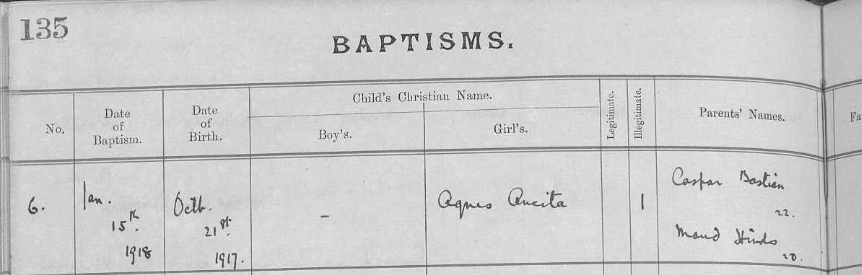
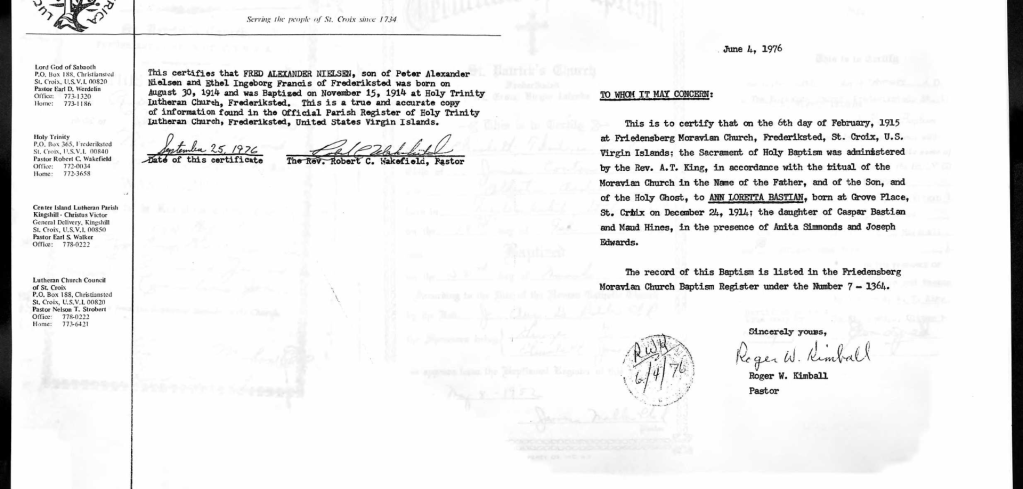
For so many years I’ve been searching for proof that my great aunt Agnes Bastian was the daughter of Casper and the full sister of Ann Loratia Bastian but that pesky baptism record eluded me for so many years, no matter what combination of names or dates I put in I just could not find that baptism record. That is until I went onto FamilySearch after a little break and saw that someone attached a document to my great aunt, I was intrigued, usually, I am the one finding records and connecting them to other people’s relatives. I wasn’t convinced even if the names sounded similar, I had never heard the middle name Ancita before so I took a closer look at the record, and there it was.
Agnes Ancita Bastian was born on October 21, 1917, and baptized on January 15, 1918, the daughter of Caspar Bastian and Maud Hinds.
Before this record popped up all I had to go by was the1930, 1940, and some travel records which unfortunately did not give her birthdate just her age and an estimated birth year which said around 1917.
So now I have confirmed that Agnes and Ann Loratia Bastian; Ann was born on December 24, 1914, and baptized on February 6, 1915, were both the daughters of Casper Bastian.
St. Croix, U.S. Virgin Islands, Slave and Free People Records, 1779-1921, Ancestry.com
There is an older sister, Esmeralda Bastian who was born on October 29, 1911, according to her baptism record but no father is recorded, given that Ann and Agnes followed after I assumed that Casper was also her father but I have no proof.
I guess I will just have to continue searching and hope that maybe another kind soul will stumble across it and link it for me again.
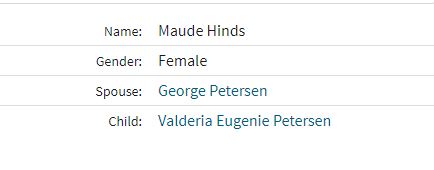
My Great Grandmother on my father’s maternal side was Valderia Eugenie Petersen, she was the daughter of Maud Hines and George Petersen.
I know a lot about Val’s mother and her mother’s maternal family but her father was a mystery because all I had was his name.
The only reason I even knew his name was because of the index for Valderia’s Social Security Application.
It has taken me 16 years to finally find his family, with the help of DNA relatives on Ancestry and knowing more about genealogy now than I did when I was 19, I was able to build a family tree of only men with the name George Petersen born between 1870 and 1905. I choose those dates because I knew Valderia was born in 1920 and her father could have been anywhere between the ages of 50 and 15. I have seen very young parents in my searches so 15 is not common but not unheard of.
I’m getting a little ahead of myself so let me backtrack a bit, before I even began my George Petersen tree I identified DNA relatives from my father’s maternal side of the family and those who were not related to Val’s mother’s side I separated and focused on building branches for them in my own tree with the hopes that I would find the connection but the higher I got on their trees the more I didn’t recognize the names. It was also more difficult because some of them didn’t have any shared connections! They were puzzles that intrigued me. I could see that they were related to each other somehow but my brother just didn’t have the same shared DNA with each of them.
This is when I got the idea to look for all the George Petersens, and there were so many of them that I just started labeling them I, II, all the way up to XIII. George Petersen XIII (13) was the one!
His full name was George Henry Petersen born on June 26, 1879, to George Henry Petersen and Lydia Gasper. Gasper also spelled as Jasper and Yasper is a name I’ve seen in my DNA relatives’ trees and I got that lightbulb feeling that this had to be him, he never showed up in any of their trees but his grandmother on his mother’s side was the half-sibling of my brother’s DNA relatives’ 3rd Great grandfather, 4th Great grandfather, and through another side, his mother was the sister of these relatives Great grandmother.
St. Croix, Danish West Indies, Denmark, Records of Enslaved and Free People, 1779-1921 for George Henry Petersen
When I entered his information into my tree and attached him as Valderia’s father, I had to wait the next day to check the Thrulines to see if it would show me anything interesting and it did.
I found 3 other DNA relatives, one of them was only 7cM which I didn’t really pay any attention to because of how small it was and they literally shared no common matches so I had no idea they belonged on my grandmother’s side but it makes me feel good because this meant that I had found the right person.
Days like these show me why I love Genealogy and pairing DNA testing with it. Conventional Geneaology can only get you so far it’s the DNA that will help you break those decade-long brick walls.
My focus now will be to find the father of my 2nd great-grandmother, Maude Hines. I know that he has to be a Hynes from St. Croix because I have DNA relatives with the Hynes last name and they share common relatives from my grandmother’s family but they do not match with my grandmother’s father or her most of her maternal side. There’s some overlap which isn’t surprising with the size of the Island but the connection is there and it’s waiting for me, I just have to find it.
I know I am late to talk about this but that’s because I’ve been waiting to see if they were doing staggered updates. It seems that everyone who was going to receive this update already received it.
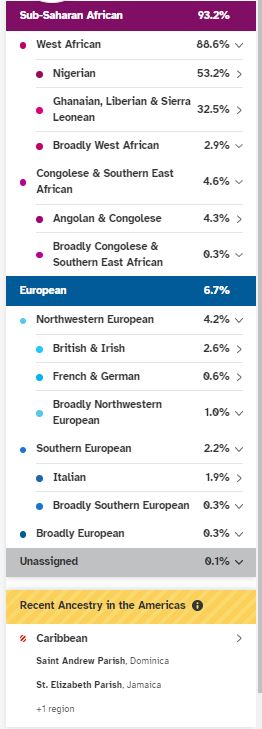
If you have no idea what I’m talking about back in January 23andMe added new Ethnolinguistic Groups to their Ancestry Composition, basically they were able to narrow down where in Africa your ancestors might have come from based on the number of Africans you matched with. This is very important to the African diaspora because the majority of us have no idea where our ancestors came from.
The Groups added include Fula & Wolof, Mandinka, Temne & Limba, Mende, Yoruba, Igbo, and so many more, you can read the full blog post from 23andMe here.
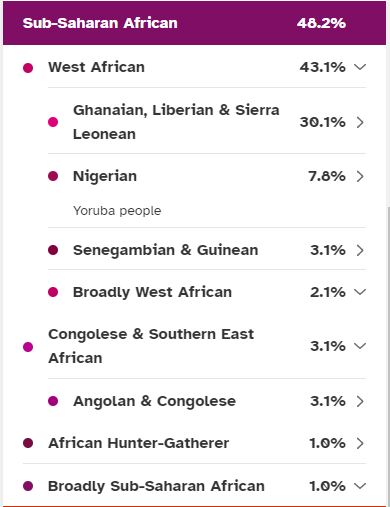
When I saw someone post their updated results on Reddit I immediately went to 23andMe to check both my father and my accounts. My father’s results were the first I saw, I was hoping to see where in Ghana our family came from but he did not receive a match for there even though it is his largest percentage. Instead, he received a match for the Yoruba people.
My Father’s Nigerian update
I clicked over to my account but I didn’t seem to have any matches. I assumed they were rolling out the update to newer accounts first but it’s been a month later and I still have no update. I honestly don’t know how they match the profiles because my father has only one full African DNA relative and he is from Angola, not Nigeria. On the other hand, I have three Nigerian and one Ghanaian DNA relative with direct ancestry from Africa.
No updates for me
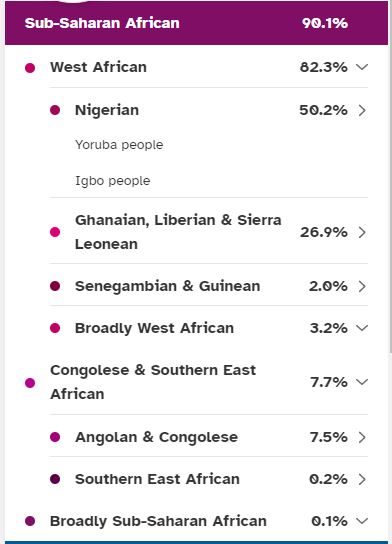
Interestingly enough, one of my aunts did 23andMe and her results came in just as they released the new groups. She is my maternal aunt and received two groups. Igbo and Yoruba. She’s also mostly African with a small bit of European which further cements the idea that we had Indigenous DNA from my maternal grandmother a tall tale. All my life I’ve been told we had Kalinago ancestry and the fact that there are Kalingao people in Dominica made it seem not unlikely, why would my mother, grandmother lie about such a thing, when I showed my results after phasing with my father my mother told me that one of my aunts said it wasn’t Kalinago but some other Asian, this can’t be true either since it would have shown up in my results, my aunts results, or even my mother and aunt’s first cousin. Both my aunt and their full first cousin show no trace of Indigenous or Asian DNA. So what’s the truth? The truth is more than likely a biracial child they tried to pass off as Asian.
Aunt Nigerian groupsComparing my aunt (left) with her full first cousin (right)
I honestly thought my mother’s maternal first cousin would help separate the DNA relatives and he has in a way but like all small Islands, there are overlaps so I’m still stuck trying to figure out how some of these people are related. All I can do at this point is hope that someone who knows more than I do is willing to share what they know.
This is a question I’ve seen asked by people new to Genealogy all the time, if you are one of these people I’m going to give you the answer to this question you’ve been searching for.
Yes, there are free Genealogy websites!
The biggest free Genealogy website is FamilySearch, the site is available in 30 languages, and is completely free. All you have to do is sign up for a free account and you will be on your way.
I’ve written about using FamilySearch before in my Finding my Roots In The Caribbean and Who are you? Joseph Boldt posts and this site is really essential, not only can you find records that are also available on Ancestry but you can find records that are not on Ancestry. When I’m working on a tree for someone I will usually go to Familysearch and look for the free records before I move over to Ancestry to find the paid sources. If you haven’t created an account on Familysearch I highly suggest you do so today.
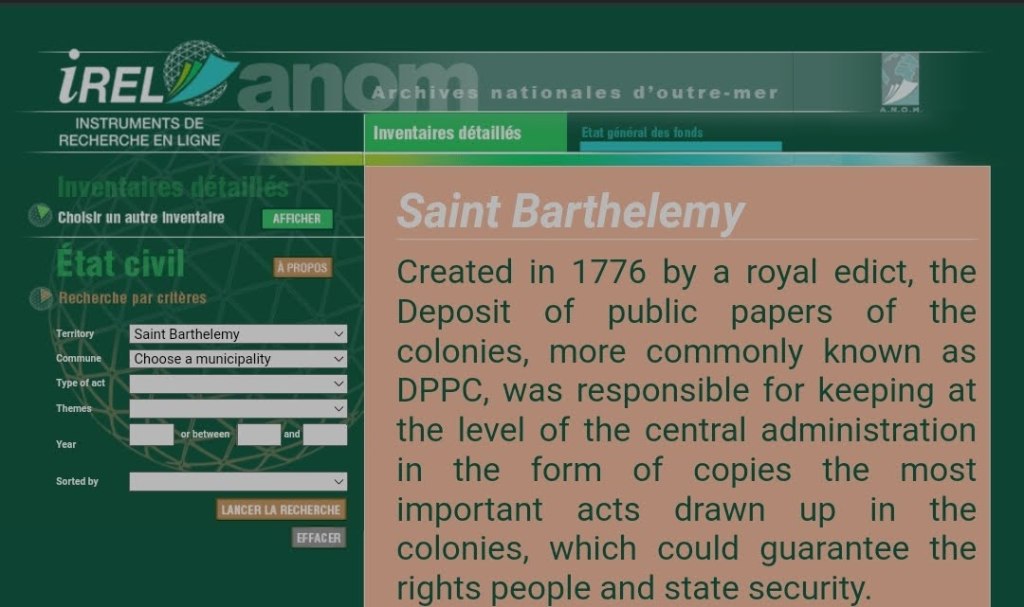
Because I mainly focus on genealogy for two specific Islands I’ll share with you the sites I use the most. For Saint-Barthélemy and pretty much all the Islands in the French Antilles I suggest using the Archives nationales d’outre-mer or Anom for short. If you are looking for someone born between 1724 and 1905 chances are very good that you find them on here. I will not lie to you but the earlier records are very difficult to read so I’d suggest you be more advanced in genealogy before attempting to look at those records. I do have to mention that for Gustavia the records only go up to 1904, for Lorient it goes to 1905. I keep hoping that they will add more records; the 1910s for instance but one can only hope.
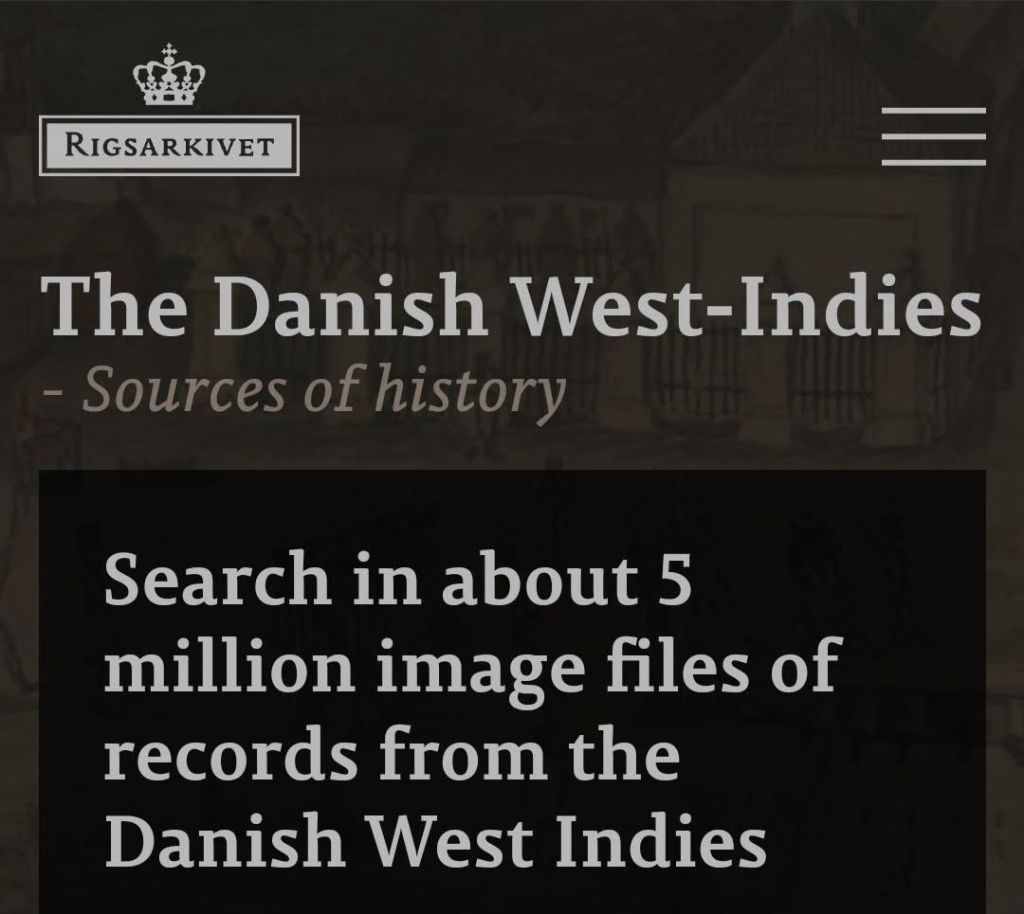
For the Danish West Indies, I use Virgin Islands History, there are so many records here that it should be one of your first stops when looking for family members from the Danish West Indies, most of it is not indexed but some are, so all you have to do is type in your surname and see what shows up.
If you are looking for more recent family then visit FamilySearch or Ancestry sometimes you will have to use both as FamilySearch has Church and Census records that Ancestry just doesn’t seem to have.
I hope this was helpful, and if you have any questions please feel free to leave a comment or visit my Instagram page and send a message there. You can find me on Instagram here :
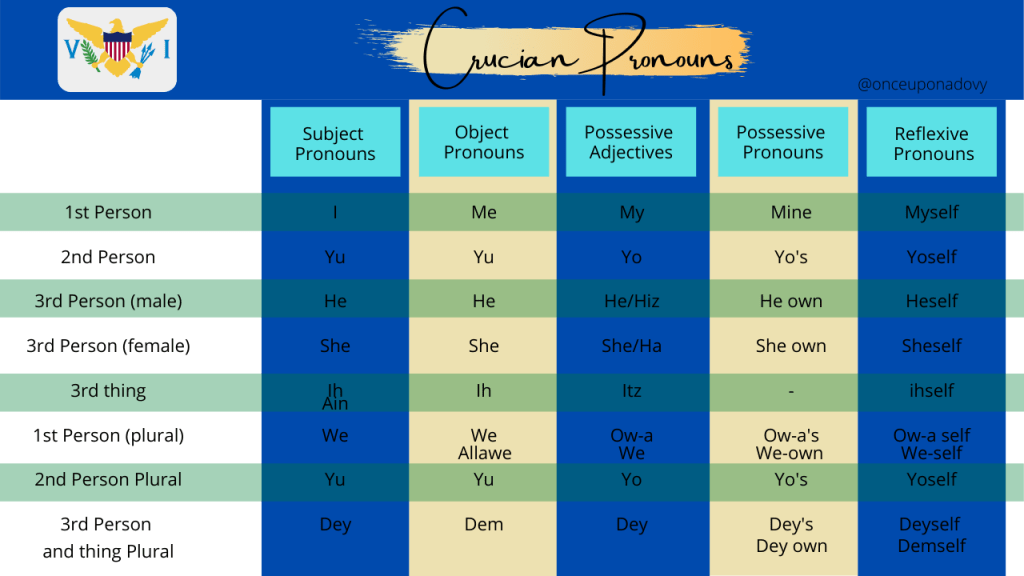
Welcome back to #CrucianwithMami, in the last lesson I spoke about Dey, the 3rd person and thing (plural) pronoun. That was the last lesson on pronouns. I created this chart that is attached below to easily recall the pronouns.
If you missed any of the lessons you can find them at the links supplied below:
For this lesson I’m going to talk about common words you should definitely know, you can find the definitions of these words and more at the Crucian Dictionary.
I would be remiss if I didn’t start with Mawnin! If you don’t say good mawnin or mawnin when meeting people or entering a store you could be met with a frosty reception. Good manners are always appreciated. It is the same for Aftanoon and good night.
Ayo, also written as al’you, ahyou, or ahyuh, you use this word in place of all of you or you guys.
Ayo does make me sick.
You guys are annoying me.
Wahs wrung wid ayo?
What’s wrong with all of you?
Baxide or Backside is simply how you would say buttocks.
Yo baxide dohn listen!
You are hard of hearing. This is mostly said in frustration.
Bigman/Bossman, this is used when referring to someone who is well respected. Basically a sign of respect.
Ay, bigman/bossman yuh co lend me a dolla or wah?
Hey, sir, can you lend me a dollar?
Bin, how we pronounce been or was.
I bin yah!
I was here!
Cy’an, used for saying can’t.
I cy’an do dat tuh she!
I can’t do that to her!
Cyar, the pronunciation of car.
Dahs he cyar deh?
Is that his car?
The cy pronunciation of words such as car, can’t, and cart are said to be other influences from our Irish overseers.
Deh, this is one of the most important words to know in Crucian because we use it all the time. It is how we say The. And if you say deh deh it means there, except in the negative form on specific occasions. To use deh deh in the negative form sometimes you have to omit one deh. Deh is also used in between sentences for reasons I have not understood yet. It is such a complex word and you really need to understand it to be able to use it effectively.
Deh dawg dem deh deh.
The dogs are there.
Me’en ova deh.
I’m not over there.
Me’en deh deh.
I’m not there.
Me’en deh yah.
I’m not here.
Dehman, basically meaning The man but it can also be used as hey, we use this saying a lot in frustration and surprise.
Aye dehman! Dehman!
Aye dehman! yuh see dat deh!
Hey! Did you see that?
Mehson, the literal translation would be my son, it’s used pretty similarly to dehman.
Welcome back to #CrucianwithMami, today I’m going to talk about Dey or They as they say it in Standard English.
In Standard English, They have five forms (They, Them, Their, Theirs, and Themselves) but in Crucian it only has four (Dey, Dem, Dey-own or Dey’s, Deyself or Demself).
No doubt you’ve noticed by now that we pronounce the th sound as d which is called Alveolar stops, it’s more than likely a carry-over from our Irish Overseers, it’s actually hilarious and interesting. The other day I was scrolling through Tiktok and came upon some Irish videos and I’ve always loved the accent so I said why not? sounds good to me. Going through several videos I landed on one of someone talking about accents from Northern Ireland and how hard it can be to understand and I paused…
What’s so hard about it? I thought to myself, I understood everything!
Anyway, here are some sample sentences:
They don’t belong here.
Dey dohn belong ya.
Are you going to the party with them?
You goin tuh deh jam wih dem?
The red one is their house.
Deh red one is dey house.
Are you going to pay for theirs too?
Yu goin tuh pay fo dey-own too?
Yu goin tuh pay for dey’s too?
His parents are going to blame themselves.
He parents dem goin blame deyself.
He parents dem goin blame demself.
Ah the lovely deyself, it is Crucian for theirselves which is a non-standard way of saying themselves. You might hear theirselves said in some dialects but it is almost never written. In Crucian it is perfectly fine to say and write deyself and I find it more natural to say deyself vs demself. Like every other nuance in Crucian, these differences just comes down to personal preferences.
Welcome back to #CrucianwithMami, today I’m going to talk about the 1st person plural We, We in Standard English has five forms (We, Us, Our, Ours, and Ourselves) in Crucian We also has five forms but they are a little bit different, in Crucian we use (We, We or Allawe, Ow-a or We, Ow-a own, We own or Ow-a’s, and Ow-a-self or Weself), where Standard English would say Us in Crucian we say We or Allawe. Allawe is simply “All of us”, we never just say us it is always All of us.
Sample Sentences:
SE: We sang as we walked.
Crucian: We does sing as we walk.
SE: We don’t want a new carpet.
Crucian: We dohn wahn a new carpet.
SE: I hope he likes us.
Crucian: I hope he like allawe.
SE: You didn’t tell us it was her birthday.
Crucian: You ain tell we ih wuz ha buttday.
SE: We are already on our way.
Crucian: We deh on ow-a/we way.
SE: Don’t tell our parents!
Crucian: Dohn tell ow-a/we parents!
SE: Their children study hard while ours never study.
Crucian: Dey chirren dem does study hard while ow-a/we/ow-a’s (own) dohn study.
I know you noticed the two placements of does, I’ve been thinking of our use of does a lot and it seems to be used when we should be using a word in the past tense. Like in the previous sentence We sang as we walked, in Crucian it was we does sing as we walk. It doesn’t always work that way though, sometimes we just use the word in its present tense like He carried something on his back would be He carry something on he back or He does carry something on he back.
SE: Your house isn’t better than ours.
Crucian: Yo house ain betta dan we/ow-a/ow-a’s (own).
You might have also noticed the own after we or ow-a. Well, this only happens when using ow-a as a possessive pronoun vs using ow-a’s.
SE: We did it ourselves.
Crucian: We do it (by) weself/ow-a-self.
SE: We didn’t enjoy ourselves.
Crucian: We’en enjoy weself/ow-a-self.
At the beginning of the lesson I said Crucian had five forms for the 1st person plural We but in actuality you can simply use just three! We, We own, and Weself. It really just comes down to your own preference.
I hope you enjoyed learning about the Crucian way of using and saying We. The next lesson will focus on the third-person plural They, I’m skipping the second person plural because it is the same as the second person Yo – Yu








 Crucianize