Tag: French West Indies

  • From Africa to the Caribbean: Links To Our Past

    From Africa to the Caribbean: Links To Our Past

    In June my father received a request to share DNA and this isn’t anything new or special because some people do request to share so they can compare their results with yours, I’ve done this myself so I accepted the request but the person that requested the share was surprising.

    This DNA relative was predicted to be a 5th cousin at 10cM but that wasn’t the surprising aspect, what intrigued me was the fact that they were 100% African.

    I know I shouldn’t be so surprised about this since my grandmother was Afro-Caribbean. This is a highly interesting match simply because I had hopes of finding a Ghanaian relative being that my father’s highest African percentage is Ghananian but this person was not Ghananian, they are Angolan.
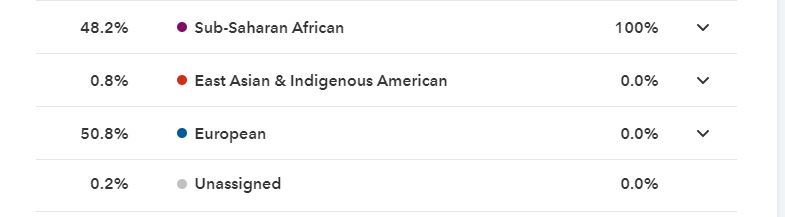
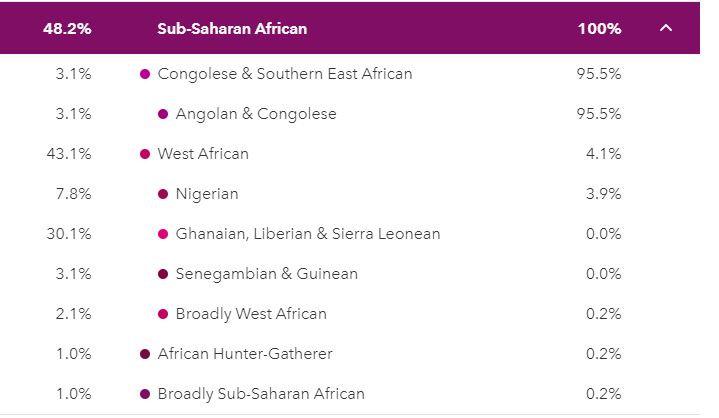
    My Fathers results vs his DNA relative
    23andme DNA results of an Angolan

    Being that it is such a small match there’s probably no way I’ll ever be able to discover which ancestor was fully Angolan. I assumed that this match would be from my Grandmother’s side since she was the Afro-Caribbean but the shared matches point to my French Grandfather’s side. There are seven matches between my father and his Angolan relative. Of the seven only one is not open to sharing their ancestry composition.
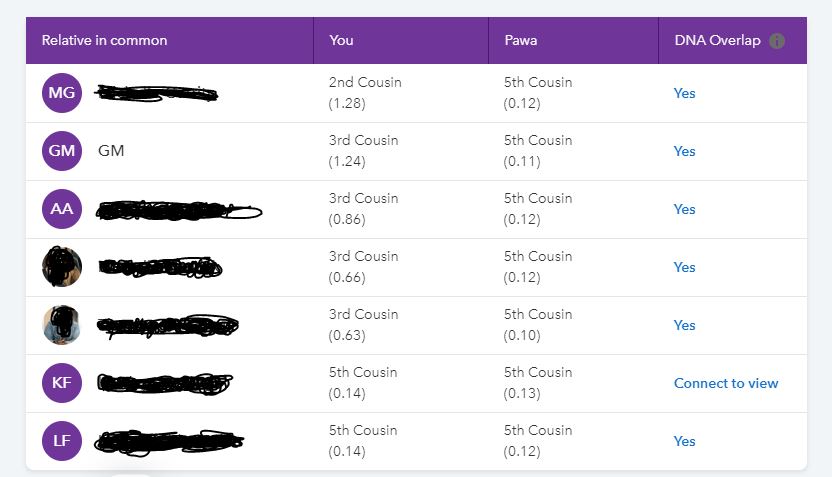
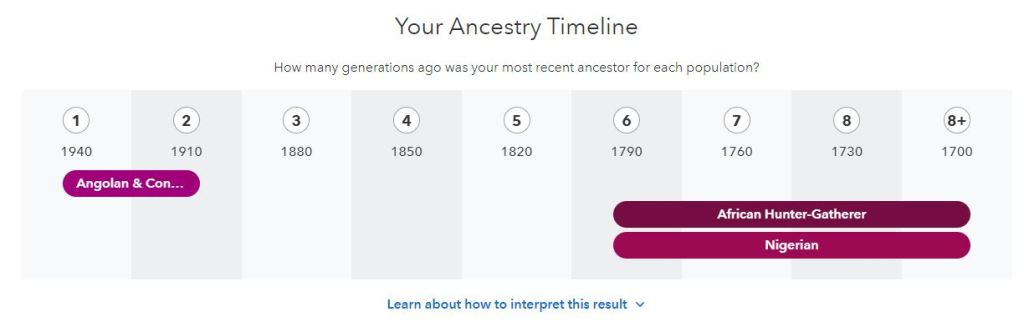
    Of the six relatives open to sharing I was able to view the DNA segments my father shared with these relatives. That particular segment in my father’s chromosome painting is identified as “African Hunter-Gatherer”. Our Angolan relative only has 0.2% African Hunter-Gatherer but people from the Congo Basin are Hunter-Gatherers of South Central Africa. There’s a very good reason why Angolan and Congolese are part of the same category on 23andme, I’ll explain that below.
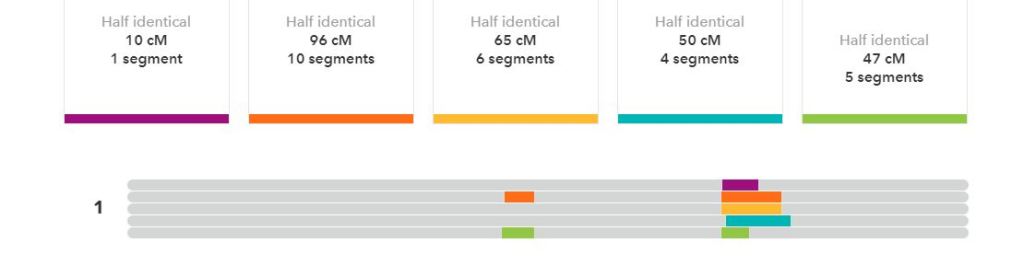
    Angolan relative is purple
    Photo by Thijs Boom on Unsplash

    Now for a little history on Angola, before the Portuguese colonized Angola, there was a pretty sizeable Kingdom located in central Africa. This Kingdom called Kingdon of Kongo comprised of northern Angola, the western portion of the Democratic Republic of the Congo, the entirety of the Republic of the Congo, and the southernmost portion of Gabon.

    This Kingdom was a highly developed state and had an extensive trading center, frequently traded with neighboring kingdoms were natural resources, ivory, copperware, metal goods, raffia cloth, and pottery.

    In 1483, the Portuguese explorer Diogo Cão landed in the Kingdom of Kongo when he sailed up the uncharted Congo River. Cão left the Kingdom with some Kongo nobles and brought them to Portugal. The Kongo nobles and Cão returned to the Kingdom in 1485. The ruling king, Nzinga a Nkuwu, converted to Christianity. In 1491, Nzinga a Knuwu was baptized and changed his name to João I. Christianity quickly became the religion of the Kongo nobles.

    In the decades that followed, the former traded goods were quickly replaced by human trafficking also known as slavery. The Kingdom has a long history of slavery, one that predates the arrival of Europeans. It’s my belief that this fact is what made it a favorite source for Portuguese traders and other European powers.

    With this little bit of history, we know why on my father’s DNA painting his DNA segment shows up as African Hunter-Gatherer and our Angolan relatives show simply as Angolan & Congolese.

    One of the DNA cousins my father shares with our Angolan relative has two grandparents from St. Vincent and it might mean nothing but in the mid-1700s we had French relatives living in St. Vincent and this is probably where our Angolan ancestor ended up in slavery. It’s just a theory but I know which lines were living there and I’m conducting a little experiment to see if everyone from that line carries a little bit of Angolan & Congolese in their Ancestry composition on 23andme.
  • My husband’s 23andme results

    Sometime last year I mentioned to my husband that 23andme was having a sale if he was still interested in doing one. His response if I remember correctly was “Hmmm”, I despise that response because I never know if he was actually listening or not, I guess this time he was because in January he walked in with the 23andme box-like “look what I got”. I had a lot on my mind so I didn’t really pay attention to when he did the test or sent it in but I do remember asking to see it when he got the results.

    I was always interested in what his results would look like. I assumed something similar to my own since his father’s family is from Guadeloupe and my father’s family is from Saint-Barthélemy, Guadeloupe, etc. My mother is from Dominica while his mother is from Benin. 23andme doesn’t have a category for Benin so most of it would probably fall under Nigeria.

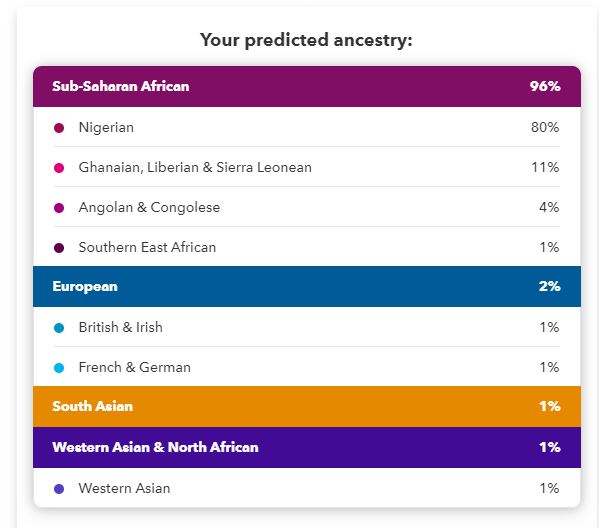
    I tried using 23andme’s Predict my ancestry tool to see what his results might look like since there was no Benin category I used Nigeria for both his mother’s father and mother and Guadeloupe for his father’s mother and father. Here’s what his predicted results look like:

    These results are not very convincing. I’m unsure why his European would only be 2%. The Nigerian is way too high, the South Asian, and WANA are both plausible, and everything else looks possible.

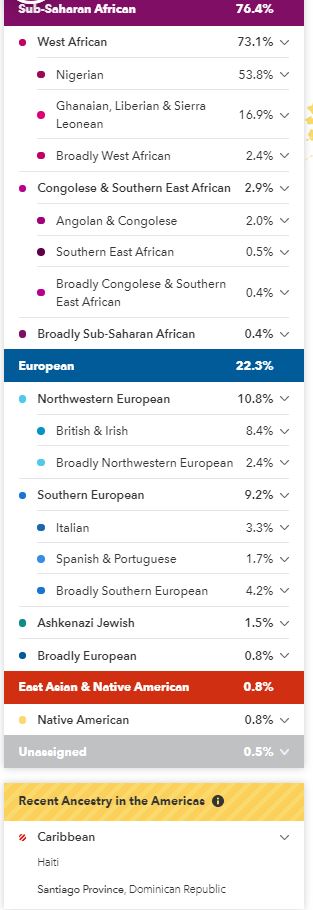
    His actual results kind of shocked me. I have to admit I am not well versed in the history of Guadeloupe but his results are very interesting. Here’s what his results are:

    Did you see what shocked me?

    No?

    His French and German are nonexistent. I really shouldn’t have been surprised as the most recent update hasn’t been very good for people with ancestry from the French Caribbean. I have no idea what the Ashkenazi Jewish is about, my father and some of our other French Antilles relatives have tiny amounts so my next adventure is to learn a bit more about Guadeloupe’s history. I knew the Native American was possible so it’s not surprising. The Recent Ancestry in the Americas did surprise me though. Haiti and the Dominican Republic, one would assume it’s from a French ancestor but I’m unsure since he has a lot of DNA relatives from other Spanish-speaking countries. He does have a few relatives from France, and we are not directly related as I had feared. There was one relative from Guadeloupe with my mother’s maiden name. I know my mother had family that moved to Guadeloupe so he might not be related to me through my father but maybe very distantly to my mother?

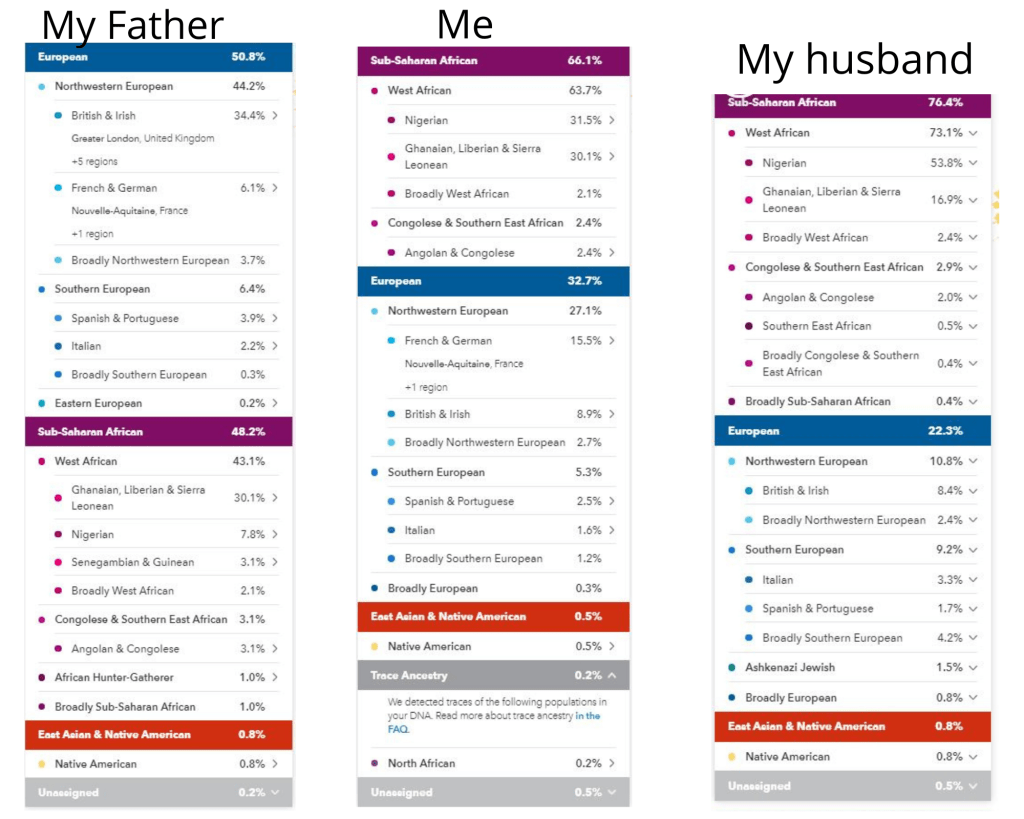
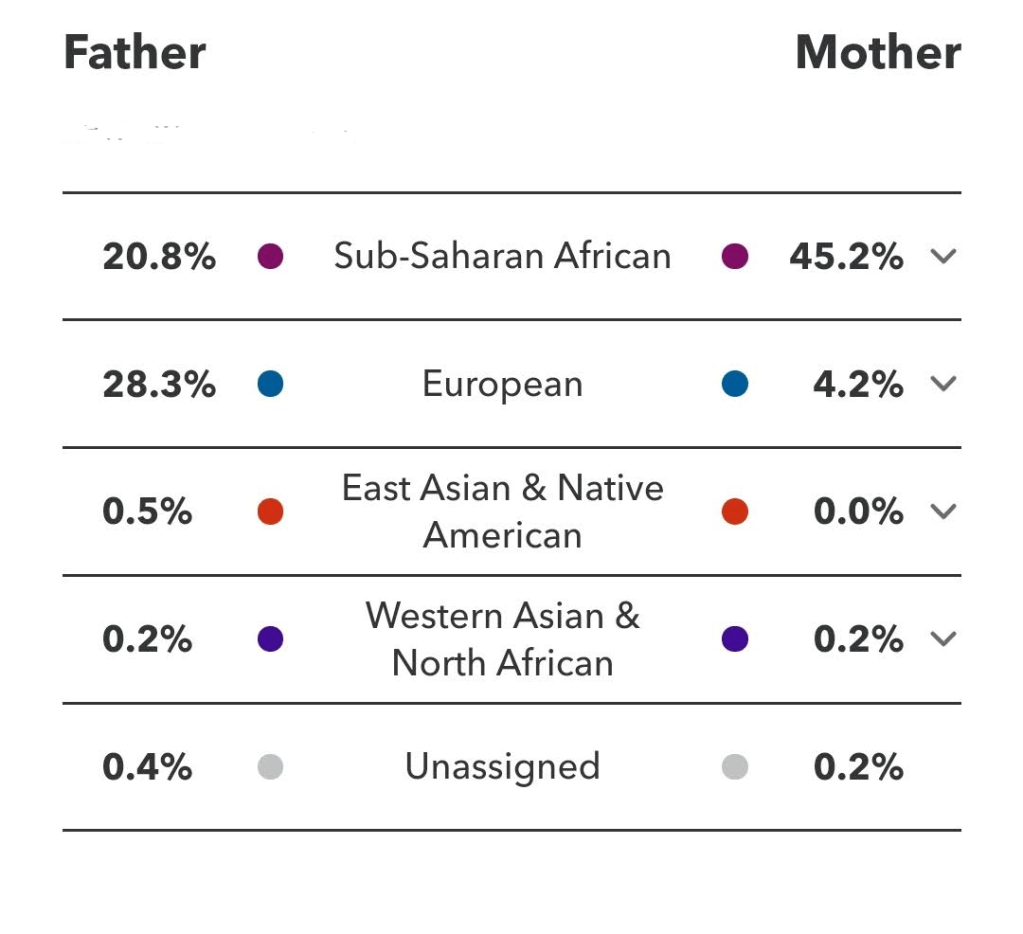
    Just because here is a compilation of My father’s results, My results, and my husband’s results:

  • Finding My Roots In The Caribbean

    I was thinking how crazy it is that I began my genealogy journey in 2006, that’s 14 years ago, way older than my oldest child. I was barely a child myself, 19 years old and I had no clue what I was doing. I just jumped on Ancestry and started putting in names my parents gave me. I hit a huge brick wall because there were so many people with the same name and people frequently used only their middle names or nicknames. I did a google search for my great grandparents’ names which lead me to a thread on Ancestry about a family with that name. It looked correct so I put it in my tree. Biggest rookie mistake ever!

    Luckily for me, it was the correct couple and that lead me to a distant cousin who had all kinds of information on my grandfather’s mother’s family. This was the first time I’d learned that her name wasn’t Josephine but Marie Josephine. The tree of this cousin took me all the way to Joseph Simon Turbé my 5x great grandfather. I assumed he was born in St. Barts as well since everyone else seemed to have been also, another rookie mistake. I did another google search which leads me to Anne Marie Danet’s post on her blog 3 – First French in the Antilles, you can see on line 24 there is a Joseph Turbe who married Anne Rose Greaux and he is the ancestor of all Turbe on the Island. This Joseph is my great grandfather. This suggested that he was from Nantes but he wasn’t born there which was a brick wall I had for a long time.

    To break this wall I scoured all over the net, looked at several family trees, and then I found a reference somewhere that said he was born in Couëron, I had never heard of this place before.

    Couëron is a commune in the Loire-Atlantique department in western France. It is part of the historic French Brittany. Couëron is one of the 24 communes of the Nantes Métropole.

    It makes a bit of sense why he would be considered a Nantes native but it is very unhelpful for a novice. So, I now knew where he was from but I had no idea where to find information about his parents. I asked a question on Wikitree in 2018 asking if anyone could help me find his Acte de naissance or Acte de baptême. A very helpful person pointed me in the right direction and I found not only his Acte de baptême but that he had a brother! I haven’t explored much of his brother’s descendants, maybe I should do that sometime soon.

    There’s a really nice blog about my great grandfather that you can read here: Capitaine Simon Joseph Turbé

    Now I work on all the families of Saint-Barthélemy, sometimes I find a link to my family and realize this stranger suddenly became a distant family member. I spoke a bit about it in my post about my Saint-Barthélemy Project last year, I actually have an update on that post that I just never posted about. I now have the ancestry of my 3x great-grandparents Anne Louise Chapelain and Pierre LaPlace thanks to the author of The Saint-Barth Islander. He was very helpful and I was able to make connections on those lines in my brother’s Ancestry DNA tree. The Joseph Chaplin that I thought was my grandmother’s brother was in fact her brother and someone made a typo on his age.

    For now, I’m working on the Governors of the US Virgin Islands/Danish West Indies. It is much more challenging work compared to researching my French ancestry. A lot of them were descendants of slaves and those records are not so easy to go through.

    If you’re also looking to do some research in the Dansk Vestindien I suggest this site Caribbean Genealogy Library or CGL for short, I find myself using the records for St. Thomas a lot when working with my French side because many of them left St. Barts and ended up in the Virgin Islands. I’m particularly fond of the:

    St. Thomas and St. John Government (archive no. 693), Reports of births, St. Thomas and St. John, 1859-1918 (nos. 30.1.1-6) and St. Thomas and St. John Government (archive no. 693), Reports of marriages, St. Thomas and St. John, 1828-1918 (nos. 30.2.1-7), these two have proven very very helpful.

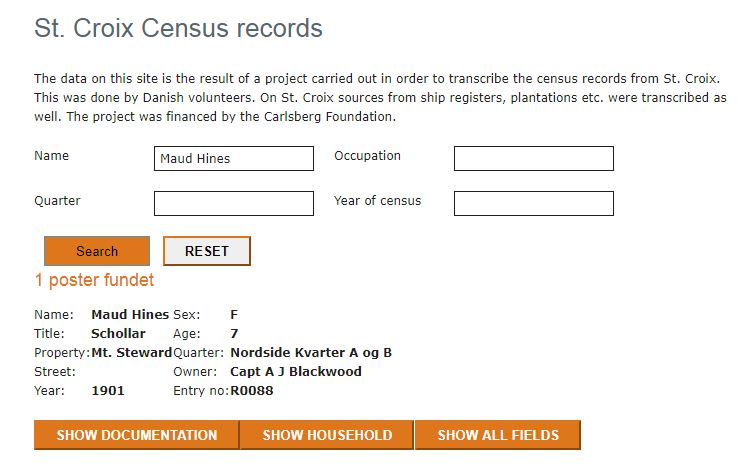
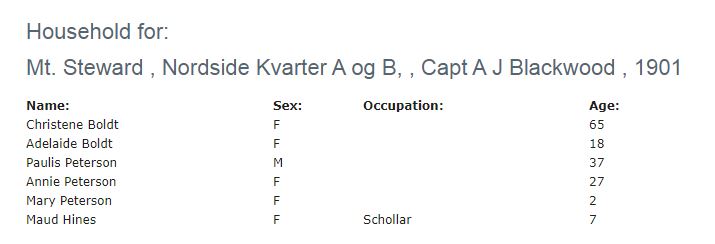
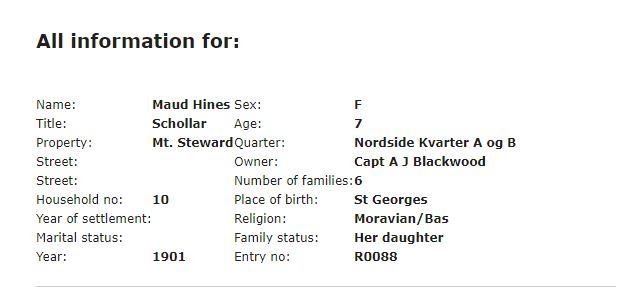
    For census records, during Danish time you can find those on Ancestry which of course requires a subscription to use but you can also find the St. Croix census on the Dansk Demografisk Database by Rigsarkivet (Danish National Archives), all you do is enter a name and it will bring you up all instances of that name appearing in the Census records.

    Show Household will display everyone that lived in the household.

    Show all Fields will show you all the information about the person you were looking for.

    It is a pain because you have to search for everyone one by one but it is free so I can’t really complain. I should note that not everyone can be found this way, the record you are looking for might not have been transcribed or the name is spelled differently than you are looking for.

    For the more recent Census records you can find them on Ancestry or you can look on FamilySearch, FamilySearch is free to use, you just have to sign up for a free account. It is a very useful site because you can also look up their free world tree to see if your relatives are already on there. If they are you will be notified when you search for records about them. You can see it circled in the photo attached.

    There are not that many of us doing Caribbean genealogy on Wikitree so if you are interested in helping I’d suggest joining and helping put our Islands on the map.

  • Phasing My 23andme With My Father

    Hello there!

    As you guys have read about before here, here, and here. I took the 23andme test in June 2018 and got my results back on July 18, 2018. I was left very underwhelmed, there was not much to learn from the results.

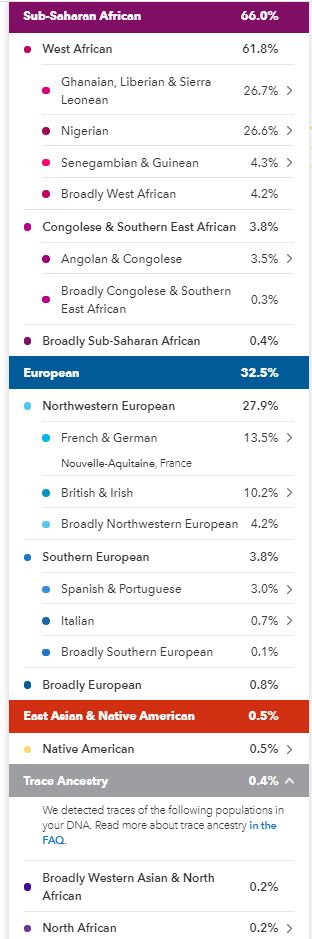
    Take a look for yourself:

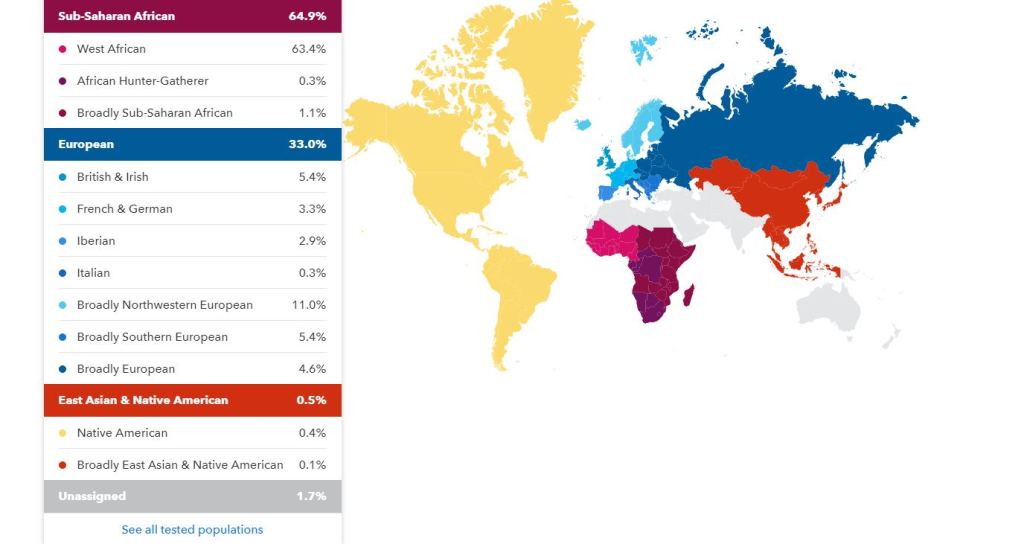
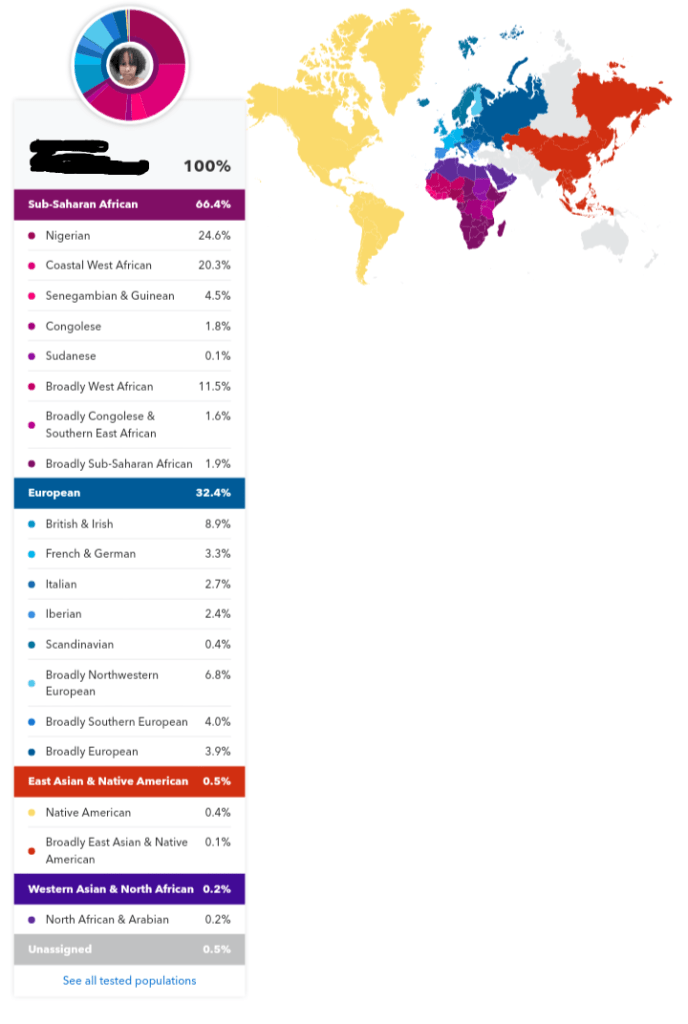
    Over 100€ for that, I thought my brother’s Ancestry test was much more informative. It was fine though, a couple of months after there was an update and it broke down the African. It still wasn’t the best but at least it wasn’t just West African anymore. My .3% African Hunter-Gatherer was gone while Nigerian, Senegambian & Guinean, Congolese, and Sudanese were separated from the broad West African category. Coastal West African while narrowed down from just West African is still a broad category not to mention the Broadly West African, Broadly Congolese & Southern East African, and Broadly Sub-Saharan African. Just a lot of Broadly.

    My European stayed mostly the same. Scandinavian at .4% was added send it made sense since my brother had Norway and Sweden which I assumed came from my Father’s mother. My grandmother’s family has been in the Danish West Indies since the first slaves were brought there. There’s also a mulatto ancestor with the surname Boldt, I admit it’s not much evidence but a cousin who descended from that same line also has Norway and Sweden. Unfortunately, Ancestry DNA doesn’t have a Chromosome browser so I can’t see where that Norway and Sweden are located and if my brother and this cousin match on that same chromosome. Since doing my research on my grandfather’s place of birth Saint-Barthélemy, I realized that Swedish could come from that side since the Swedish colonized the Island from 1784 to 1877.

    I should note that my African went up and my European went down, not by much but I found it interesting nonetheless. My Native American stayed the same and I gained Western Asian and North African.

    In May 2019 my results went through another update, they called this a Beta update, my African portion was broken down, even more, I lost the Sudanese but gained Ghanaian, Liberian & Sierra Leonean, the Congolese & Southern East African got a break down showing Angolan & Congolese but there were still those pesky Broadly categories.

    My European had a revamp, the Iberian category was renamed to Spanish & Portuguese, I lost the little bit of Italian I had. My Native American once again stayed the same. Strangely, I had Central & South Asian added at 0.1%, seeing how categories at that level seem to vanish I didn’t expect to see it at the next update.

    Now we’re at my most recent update before I phased with my father. It was updated around September 2019 but if you remember I was pregnant and sick during that time so I didn’t see the update until April of this year. My African Hunter-Gatherer is back at the same percentage too. Southern East African was added at .1%. My Western Asian & North African went up. I had a location for France, Nouvelle-Aquitaine which lines up perfectly with my paper trail, and I had a Caribbean location Dominica, which is right on the money since both my Mother’s parents were from there.

    For Father’s Day, I decided I was going to buy my father a 23andme kit, it wasn’t a surprise since I had spoken to both parents about it and they were interested, my father got his kit in July and his results were ready earlier this month. I’m not going to lie but I didn’t expect anything in his composition other than European and African. What he received shocked me.

    My father apparently has Native American ancestry. Never in my life has anyone ever mentioned him having Native American anywhere in any of his family lines and since both his parents have passed I have no one to ask about it and will probably never find out where it comes from. Even better?

    My Native American comes from him. All my life I was told my Mother’s mother had Kalinago ancestry and when I saw Native American in my composition I assumed it came from my Grandmother, jokes on me though, it could have come from a Grandmother, just not the one I thought.

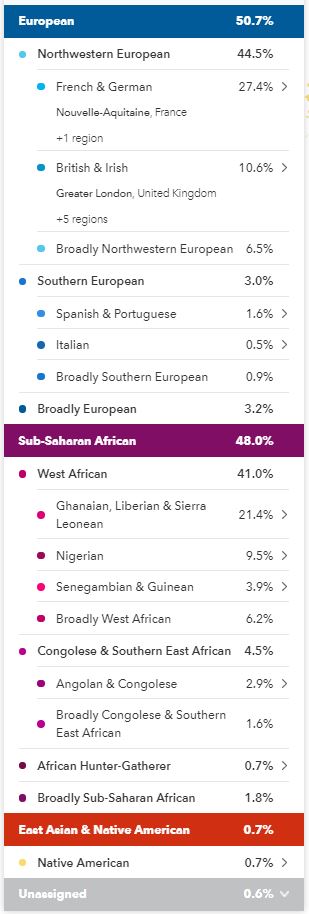
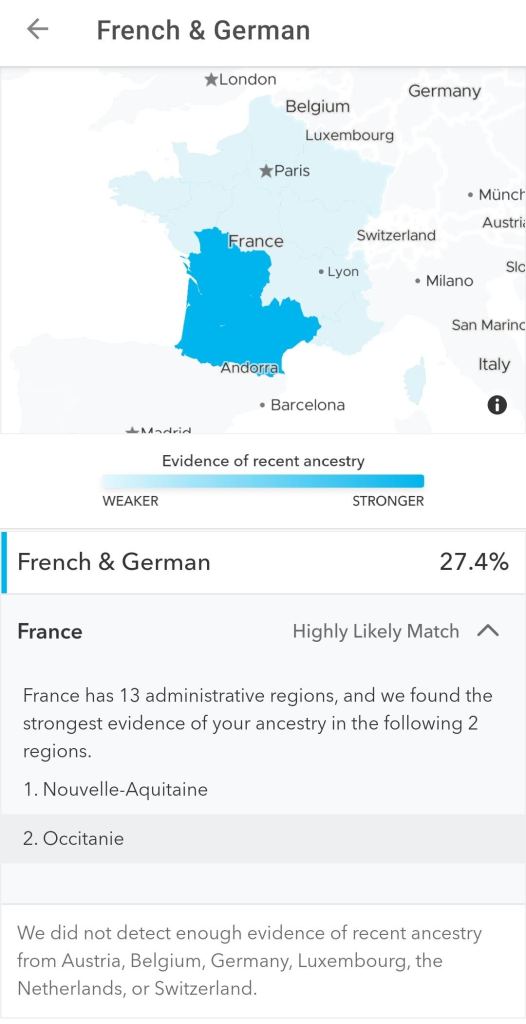
    My Father has two regions in France and six in the United Kingdom. Nouvelle-Aquitaine and Occitanie line up perfectly with our paper trail but all the United Kingdom regions are a mystery.

    Here are my results after phasing with my father. My African Hunter-Gatherer is gone once again. Italian has reappeared. My West Asian & North African has gone down again, this time they are trace ancestry.

    I guess my course of action now is to test my Mother and see what secrets her DNA is hiding.

  • New 23andme beta update

    So last night 23andMe released their beta update.

    I spoke about it on this post 23andMe: Changing Ancestry Composition.

    If this is your first time hearing about it, 23andMe is a DNA testing company, it’s one of the more well-known ones, you have Ancestry, 23andMe, MyHeritage, and FTDNA, which does big y DNA testing.

    Along with the introduction of Trace Ancestry category. My estimates have gone through quite the change.

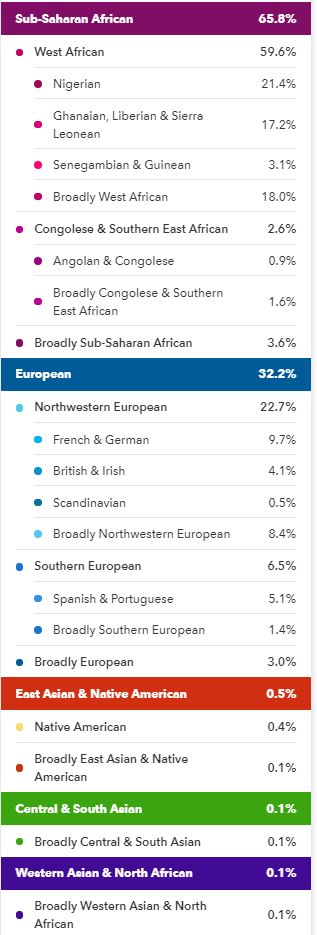
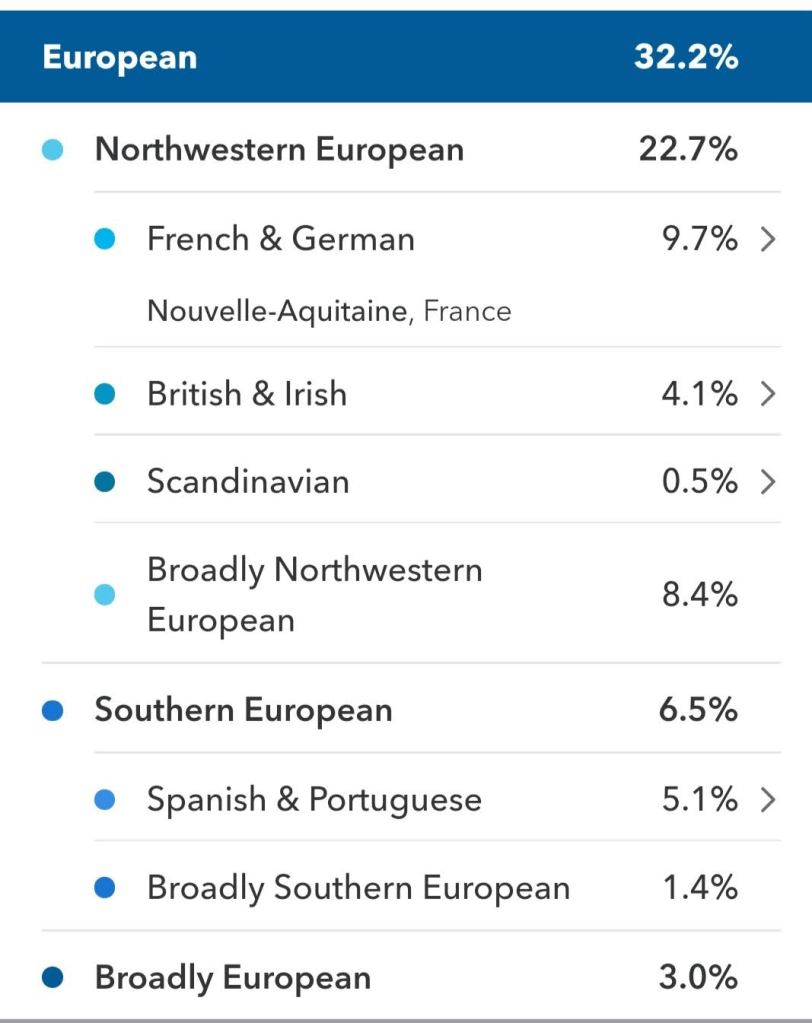
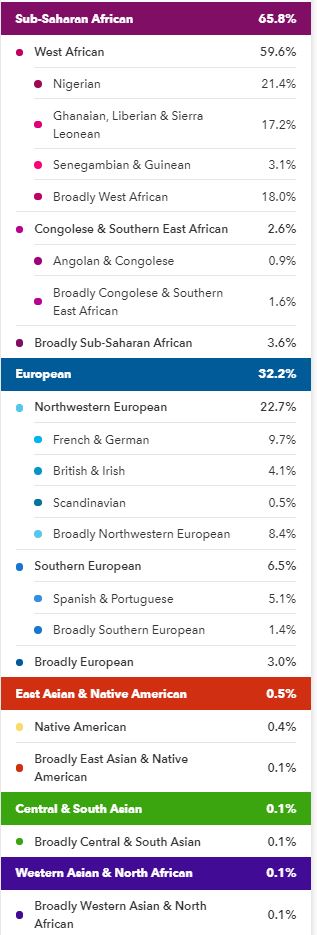
    I’ve always found my French & German percentage to be on the small side for having a father who is half French. This estimate is more understandable. I went from 3.3% to 9.7%. My British & Irish also went down, for the longest time it was higher than my F&G and it shouldn’t have been. It’s nice to see that they’ve shifted some of the B& I over to F&G where it belongs. I just hope they’ll be able to do the same with Spanish & Portuguese because I have no known ancestry from those areas, what I do have is Ancestors who lived in border towns so maybe, just maybe they were S&P?

    Here’s my complete update:

  • My Saint-Barthélemy Genealogy Project

    Hey Everyone!

    I don’t remember if I spoke about my Saint-Barthélemy project on Wikitree before but I have one. Which you can view here. It’s basically me researching and talking about the history of the island and its people because my Father’s paternal side of the family is from there. The funny thing about Saint-Barthélemy is that it was a very endogamous place so I’m related to a lot of people in a lot of different ways. There were cousin marriages, double cousins, and half-siblings galore.

    If you’ve never heard of Wikitree before it is a World Family tree that is very source-based, meaning you need solid proof to link to the world tree. It took me about 4 years to connect to the world tree and it was not easy because Caribbean-based profiles were basically nonexistent on the site. Like everywhere else it was mostly American and British profiles, I managed to build up a very good portion of the St. Barts community with the help of distant cousins who entered their branches. This played a major role in me developing my project, I wanted to see how many different ways I’d connect to some of these distant cousins so I set out to put up all the family members of the different branches, I’m not even half done because there are still so many people I haven’t found in the records yet.

    I’ve been able to connect my Grandfather’s line all the way back to Île d’Yeu and Nantes, France. There is one line, my Chapelain line that I just can’t seem to break through, I know my 3x great grandmother Anne Louise Chapelain sometimes spelled Chapelin was born about 1835 in Saint-Barthélemy and she married my 3x great grandfather Pierre LaPlace sometime around 1856, I’m assuming because I have a 2x great uncle named Louis Joseph LaPlace who was born on July 28, 1857, according to his marriage certificate.

    Acte de mariage: Archives nationales d’outre-mer, Etat civil numérisé, Saint-Barthélemy, Gustavia, Mariage (1880), Page 3 (acte n°3), accessed on http://anom.archivesnationales.culture.gouv.fr/

    I could not find any other children for this couple beside my uncle and my 2x great grandfather Gabriel.

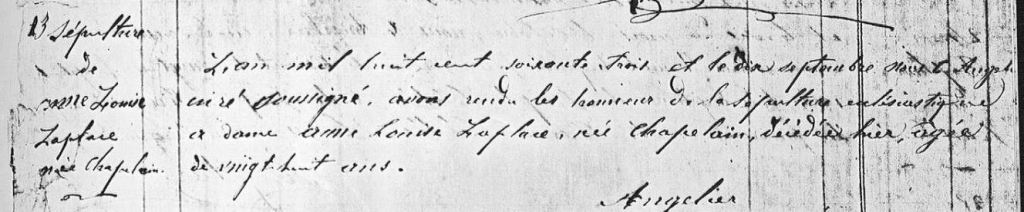
    Gabriel was born on March 4, 1862, according to his marriage certificates (he was married twice) and Anne Louise passed away on September 9, 1863. Her death record as you can see doesn’t list any parents for her so I have no clue who they are, I have also not found a marriage certificate for my grandparents.

    Acte de décès: Archives nationales d’outre-mer, Etat civil numérisé, Saint-Barthélemy, Lorient, Tous actes (1863), Page 9 (acte n°13), accessed on http://anom.archivesnationales.culture.gouv.fr/

    What I did find though was a reference to a 3x uncle by name of Joseph Chaplin in the witnesses for Gabriel’s second marriage.

    Acte de mariage: Archives nationales d’outre-mer, Etat civil numérisé, Saint-Barthélemy, Gustavia, Mariage (1888), Page 8 (acte n°9), accessed on http://anom.archivesnationales.culture.gouv.fr/

    This Joseph would be a very young brother so I’m assuming he was a half brother but I can find no other traces of him.

    For now, I’m going to continue with my project and hope that I find something that can help me break down this brick wall.

    Talk to you guys later!