Tag: Crucian language

  • 11 Most Common Crucian Words

    11 Most Common Crucian Words

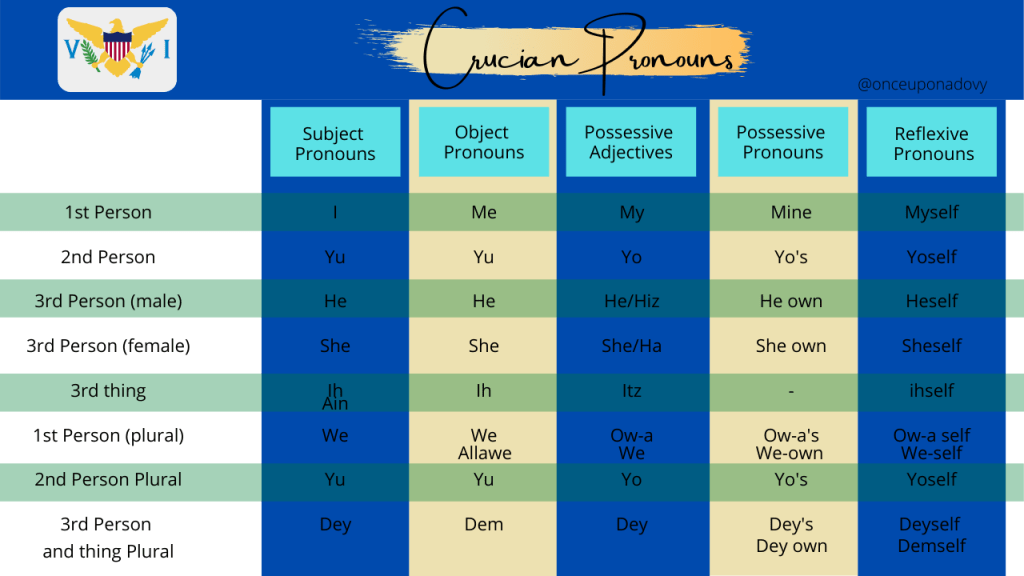
    Welcome back to #CrucianwithMami, in the last lesson I spoke about Dey, the 3rd person and thing (plural) pronoun. That was the last lesson on pronouns. I created this chart that is attached below to easily recall the pronouns.
    If you missed any of the lessons you can find them at the links supplied below:

    I – Me’en, Yo- Yu, S/He, Ih and Ain, We, and Dey

    For this lesson I’m going to talk about common words you should definitely know, you can find the definitions of these words and more at the Crucian Dictionary.

    I would be remiss if I didn’t start with Mawnin! If you don’t say good mawnin or mawnin when meeting people or entering a store you could be met with a frosty reception. Good manners are always appreciated. It is the same for Aftanoon and good night.

    Ayo, also written as al’you, ahyou, or ahyuh, you use this word in place of all of you or you guys.

    Ayo does make me sick.

    You guys are annoying me.

    Wahs wrung wid ayo?

    What’s wrong with all of you?

    Baxide or Backside is simply how you would say buttocks.

    Yo baxide dohn listen!

    You are hard of hearing. This is mostly said in frustration.

    Bigman/Bossman, this is used when referring to someone who is well respected. Basically a sign of respect.

    Ay, bigman/bossman yuh co lend me a dolla or wah?

    Hey, sir, can you lend me a dollar?

    Bin, how we pronounce been or was.

    I bin yah!

    I was here!

    Cy’an, used for saying can’t.

    I cy’an do dat tuh she!

    I can’t do that to her!

    Cyar, the pronunciation of car.

    Dahs he cyar deh?

    Is that his car?

    The cy pronunciation of words such as car, can’t, and cart are said to be other influences from our Irish overseers.

    Deh, this is one of the most important words to know in Crucian because we use it all the time. It is how we say The. And if you say deh deh it means there, except in the negative form on specific occasions. To use deh deh in the negative form sometimes you have to omit one deh. Deh is also used in between sentences for reasons I have not understood yet. It is such a complex word and you really need to understand it to be able to use it effectively.

    Deh dawg dem deh deh.

    The dogs are there.

    Me’en ova deh.

    I’m not over there.

    Me’en deh deh.

    I’m not there.

    Me’en deh yah.

    I’m not here.

    Dehman, basically meaning The man but it can also be used as hey, we use this saying a lot in frustration and surprise.

    Aye dehman! Dehman!

    Aye dehman! yuh see dat deh!

    Hey! Did you see that?

    Mehson, the literal translation would be my son, it’s used pretty similarly to dehman.

    Mehson, me’en no wah wrong wid she!

    I don’t know what’s wrong with her!

  • Lessons in Crucian: Dey

    Lessons in Crucian: Dey

    Welcome back to #CrucianwithMami, today I’m going to talk about Dey or They as they say it in Standard English.

    In Standard English, They have five forms (They, Them, Their, Theirs, and Themselves) but in Crucian it only has four (Dey, Dem, Dey-own or Dey’s, Deyself or Demself).

    No doubt you’ve noticed by now that we pronounce the th sound as d which is called Alveolar stops, it’s more than likely a carry-over from our Irish Overseers, it’s actually hilarious and interesting. The other day I was scrolling through Tiktok and came upon some Irish videos and I’ve always loved the accent so I said why not? sounds good to me. Going through several videos I landed on one of someone talking about accents from Northern Ireland and how hard it can be to understand and I paused…

    What’s so hard about it? I thought to myself, I understood everything!

    Anyway, here are some sample sentences:

    They don’t belong here.

    Dey dohn belong ya.

    Are you going to the party with them?

    You goin tuh deh jam wih dem?

    The red one is their house.

    Deh red one is dey house.

    Are you going to pay for theirs too?

    Yu goin tuh pay fo dey-own too?

    Yu goin tuh pay for dey’s too?

    His parents are going to blame themselves.

    He parents dem goin blame deyself.

    He parents dem goin blame demself.

    Ah the lovely deyself, it is Crucian for theirselves which is a non-standard way of saying themselves. You might hear theirselves said in some dialects but it is almost never written. In Crucian it is perfectly fine to say and write deyself and I find it more natural to say deyself vs demself. Like every other nuance in Crucian, these differences just comes down to personal preferences.

  • Lessons in Crucian – We

    Lessons in Crucian – We

    Welcome back to #CrucianwithMami, today I’m going to talk about the 1st person plural We, We in Standard English has five forms (We, Us, Our, Ours, and Ourselves) in Crucian We also has five forms but they are a little bit different, in Crucian we use (We, We or Allawe, Ow-a or We, Ow-a own, We own or Ow-a’s, and Ow-a-self or Weself), where Standard English would say Us in Crucian we say We or Allawe. Allawe is simply “All of us”, we never just say us it is always All of us.

    Sample Sentences:

    SE: We sang as we walked.

    Crucian: We does sing as we walk.

    SE: We don’t want a new carpet.

    Crucian: We dohn wahn a new carpet.

    SE: I hope he likes us.

    Crucian: I hope he like allawe.

    SE: You didn’t tell us it was her birthday.

    Crucian: You ain tell we ih wuz ha buttday.

    SE: We are already on our way.

    Crucian: We deh on ow-a/we way.

    SE: Don’t tell our parents!

    Crucian: Dohn tell ow-a/we parents!

    SE: Their children study hard while ours never study.

    Crucian: Dey chirren dem does study hard while ow-a/we/ow-a’s (own) dohn study.

    I know you noticed the two placements of does, I’ve been thinking of our use of does a lot and it seems to be used when we should be using a word in the past tense. Like in the previous sentence We sang as we walked, in Crucian it was we does sing as we walk. It doesn’t always work that way though, sometimes we just use the word in its present tense like He carried something on his back would be He carry something on he back or He does carry something on he back.

    SE: Your house isn’t better than ours.

    Crucian: Yo house ain betta dan we/ow-a/ow-a’s (own).

    You might have also noticed the own after we or ow-a. Well, this only happens when using ow-a as a possessive pronoun vs using ow-a’s.

    SE: We did it ourselves.

    Crucian: We do it (by) weself/ow-a-self.

    SE: We didn’t enjoy ourselves.

    Crucian: We’en enjoy weself/ow-a-self.

    At the beginning of the lesson I said Crucian had five forms for the 1st person plural We but in actuality you can simply use just three! We, We own, and Weself. It really just comes down to your own preference.

    I hope you enjoyed learning about the Crucian way of using and saying We. The next lesson will focus on the third-person plural They, I’m skipping the second person plural because it is the same as the second person Yo – Yu

    See you at the next lesson!

  • Lessons in Crucian: Ih and Ain

    Lessons in Crucian: Ih and Ain

    Welcome back to #CrucianwithMami, today I’m going to talk about the 3rd thing Pronoun Ih or as they say in Standard English It.

    Ih is an interesting word while it means “it” it can also be used to say “there’s”. With Crucian it’s really best to learn by listening since there really aren’t any formal rules you just hear and repeat. I guess this is why our writing system is so fractured everyone writes the words in their own interpretation to how it sounds.

    As for Ain, it seems to only be used in the negative form in specific situations. I haven’t really figured out what those situations are yet.

    In Standard English, It has three forms It, Its, and Itself. Ih also has three forms in Crucian, Ih, Itz, and Itself.

    Here are the sample sentences:

    SE: It was just on the floor over there.

    Ih wuz jus on deh floor ova deh

    SE: Can you dig a hole and cover it?

    Yu co dig a hole an cova ih?

    SE: Is that its tail?

    Iz dah itz tail?

    SE: Did you see that dog free itself?

    Yu see dah dawg free ihself?

    SE: It doesn’t have anything to do with me.

    Ain gah nuttin tuh do wid me.

    In the next lesson, I will focus on 1st person plural We.

  • Lessons in Crucian- S/He

    Lessons in Crucian- S/He

    Welcome back to #CrucianwithMami, in the last lesson I mentioned that I was going to focus on the 3rd person pronoun He but I felt like it made more sense to talk about both He and She since they are very similar.

    In Standard English, He and She both have four forms (He, She, Him, Her, His, Hers, Himself, and Herself) in Crucian He and She also have four forms (He, She, Hiz, Ha, He own, She own, Heself, and Sheself).

    As you no doubt noticed we don’t say Him or Her it’s He and She, once more I don’t exactly know why but I’m sure there’s a reason for that.

    Here are the sample sentences:

    Subject Pronouns

    SE: He is not going to like this one.

    He’n gon like dis one.

    SE: She is not a fan of this color.

    She’n a fan of dis cula.

    Object Pronouns

    SE: Is that him over there?

    Das he ova deh?

    SE: Is that her dancing in the corner?

    Das she dancing in deh corna?

    Possessive Adjectives

    SE: That’s his chain.

    Das hiz chain

    SE: That’s her children.

    Das ha children

    Possessive Pronouns

    SE: That car is his.

    Da cyar is he own

    SE: That child is hers.

    Da chile is she own.

    Reflexive Pronouns

    SE: You see all of that? He did it by himself.

    You see all ah dat deh? He did it all by heself.

    SE: She made that dress all by herself.

    She make dah dress all by sheself

    While I was doing this lesson I realized that sometimes instead of Hiz or Ha I sometimes will use He or She, I hadn’t noticed until I started forming the sentences. I find that very interesting because by itself I will say Hiz for his and Ha for hers but in a sentence, it is more natural to say He or She.

    In the next lesson, I will talk about 3rd thing, It or Ih as we say in Crucian.

  • Lessons In Crucian: Yo -Yu

    Lessons In Crucian: Yo -Yu

    Welcome back to #CrucianwithMami, today I am going to talk about the Crucian second person pronoun Yu sometimes said as Yo.

    In Standard English you have four forms (You, Your, Yours, and Yourself) in Crucian there are also four forms (Yu, Yo, Yo’s, and Yoself)

    I wish I could offer an in-depth explanation as to why we say Yoself in Crucian rather than Yurself but I feel like I’m learning about my own language alongside you!

    Here are some sample sentences:

    SE- You are a student.

    Yu a student.

    SE- Wash your hands.

    Wash yo hand dem. (I will explain dem in another lesson)

    SE- Is that yours?

    Das yo’s?

    SE- Did you do it by yourself?

    Yu do it by yoself?

    You can listen to the audio clip here:

    In the next lesson, I will talk about the third person pronoun (male) He.

  • Lessons In Crucian: I – Me’en

    Lessons In Crucian: I – Me’en

    Welcome to the first lesson of #CrucianwithMami, I originally wanted to start with the word “Deh” but I’ll leave that for the next lesson.

    Today we are focusing on the two forms of I that are used in Crucian, the affirmative form I and the negative Me’en.

    There are no strict rules when using I but Me’en is never used in the affirmative form.

    If you wanted to say I’m home in Crucian you’d say – I home or I deh home

    If you wanted to say I’m not home in Crucian you’d say – Me’en home or Me’en deh home

    Another way you’d say that in Crucian would be – I’n home or I’n deh home

    Unlike other languages, there are no informal or formal forms as the entire language is considered informal. Using either Me’en or I’n just seems to be a personal preference.

  • Beginning Crucian with Mami

    I originally posted about this on the Facebook page and realized that I had not posted about it on the blog, I sincerly apologize for that.

    You might notice a new tab on the blog’s menu “Crucian with Mami” well that’s there because I started a mini-series in an attempt to teach my children Crucian.

    On December 19, 2020, I decided I was going to do something about the fact that my son doesn’t speak the local creole from where we were born, this is what I posted on Facebook:

    Being an Expat parent is not easy especially when your child speaks only the community language and not your mother tongue so today I’m starting a mini-series: Crucian with MamiIn Crucian (the creole of St. Croix, US Virgin Islands, where I’m from) we call our mother’s Mami. My son stopped calling me Mami when we moved to France in 2015, social pressure, everyone calls their grandmother Mamie and their mother Maman. It’s an indescribable feeling going through a terrible pregnancy, waiting 9+ months for your child to finally call you Mami, and then just like that in the blink of an eye, it’s taken from you. It felt like he forgot me. I understand fitting in when out and about in public but I had hoped that we could still keep a little of our culture at home. As it is now my son doesn’t talk to any of my family, he says he doesn’t understand them because he only speaks French. I don’t want this for my children so from today, we are going to be doing Crucian classes with Mami. My classes will teach the difference between standard English and Crucian, we’ll listen to Crucian music, hopefully, eat Crucian food, and read Crucian literature. As we say in Crucian “Leh we go!” (Let’s go!)

    Crucianize

    I started going over the language and trying to figure out the most important aspects of it so that I could teach the children. I decided I would start with the word Deh, I recorded a sound clip and soon realized that it would be much better to start with pronouns in Crucian.

    For the first lesson, I covered the two forms of I used in Crucian.